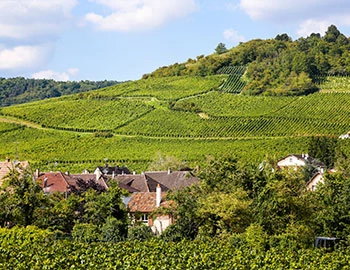

Cuvée Garnacho, Séguret rouge 2023
AOP Côtes-du-Rhône Village, Domaine de Cabasse, 750 ml


Description
Aromas of ripe fruit with a velvety note and a hint of spice caress the nose. On the palate, it is powerful, full-bodied, with well-integrated tannins and a long finish. A full-bodied and at the same time fruity wine that excellently brings out the character of the Grenache grape.
Attributes
| Grape variety: | Grenache, Syrah, Carignan, Counoise |
| Producer: | Domaine de Cabasse |
| Origin: | France / Rhône / Côtes du Rhône/Villages |
| Ripening potential: | 7 to 8 years |
| Drinking temperature: | 16 to 18 °C |
| Food Pairing: | Spiced grillades, Cheese board |
| Vinification: | fully destemmed, fermentation in steel tank |
| Harvest: | hand-picking |
| Maturation: | in large wooden barrel/foudre |
| Maturation duration: | 9 months |
| Volume: | 14.5 % |
| Note: | Contains sulphites |
Syrah
A hint of pepper
The legend stubbornly persists that the Syrah variety came from the Persian city of Shiraz. Yet, researchers have shown that it is a natural crossing of two old French varieties: the red Dureza from the Rhône Valley and the white Mondeuse blanche from Savoy. Wines from Syrah are gentle and concentrated. They smell of dark berries, violets and liquorice, and amaze with a piquant touch of white pepper. As varietal wines, they are found on the northern Rhone, as in the Hermitage or Côte Rôtie appellations, as well as in Swiss Valais. In the southern Rhône Valley, Syrah is often wedded with Grenache and Mourvèdre. In 1832, a Frenchman brought the variety to Australia, where it became the emblem of the national wine industry. There, the weightiest versions develop with typical notes of tar and chocolate.
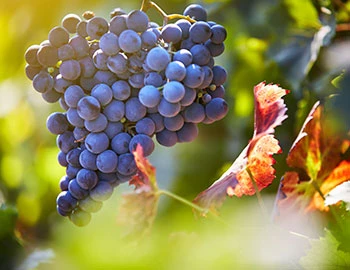
Carignan
Fervid oddball
The red Carignan is a heat-loving Mediterranean grape. It has a bit of everything over other varieties: more colour, more tannins, more acid. It is not easy to press a harmonious wine from it alone. Hence it is most often encountered as a blend partner, as in the Côtes du Rhône wines. In Spain it is called Mazuelo and is part of the traditional Rioja recipe. It provides the wines’ acidic backbone. The most exciting varietal specimens come from the slate slopes of the Catalan Priorat (named here Cariñena), from old bush vines in Chile or from Sardinia, where it is known as Carignano. When pressed properly, this oddball generates a lush bouquet of plums and dark fruits. Its origins lie in the northwest Spanish Aragon, near the town of Cariñena. The surrounding wine area is also named after it. In order to prevent confusion with the vine, it is called Samsó there.
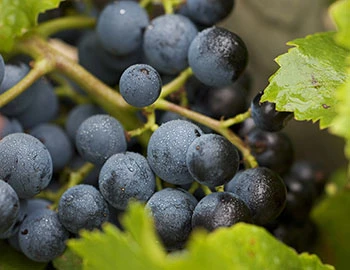
Syrah
A hint of pepper
The legend stubbornly persists that the Syrah variety came from the Persian city of Shiraz. Yet, researchers have shown that it is a natural crossing of two old French varieties: the red Dureza from the Rhône Valley and the white Mondeuse blanche from Savoy. Wines from Syrah are gentle and concentrated. They smell of dark berries, violets and liquorice, and amaze with a piquant touch of white pepper. As varietal wines, they are found on the northern Rhone, as in the Hermitage or Côte Rôtie appellations, as well as in Swiss Valais. In the southern Rhône Valley, Syrah is often wedded with Grenache and Mourvèdre. In 1832, a Frenchman brought the variety to Australia, where it became the emblem of the national wine industry. There, the weightiest versions develop with typical notes of tar and chocolate.
Counoise
Crisp, rare and elegant
This sparsely-stocked red grape spawns astonishingly crisp wines. It is cultivated in small quantities in the southern Rhône Valley and the Languedoc. However, it originated in Spain. Legend has it that Pope Urban V (1310-1370), the penultimate Avignon Pope, received a vine as a gift from a Spaniard named Counesa.
This variety matures late, with weak productivity; its high quality makes up for it, though. In total, nearly 1,000 hectares are planted with Counoise in France. Wines pressed from the Counoise grape are mostly light in color, elegant, multi-layered, and fruity.
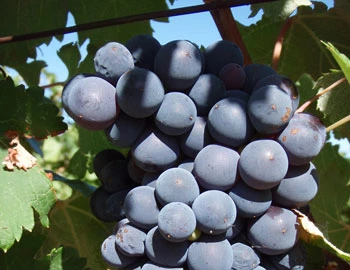
Rhône
Rhône: northern power, southern charm
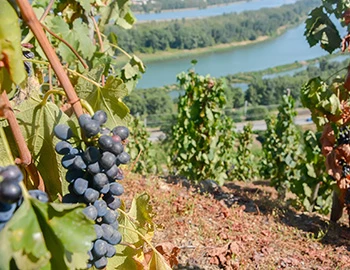
The Rhône’s source is in Valais, and it flows into the Mediterranean 800 kilometres to the south. In the last 200 kilometres of its course, it is lined with vines which yield a range of red crus that are among the most prestigious wines in the world – for example, on the spectacular cliffs of the Hermitage Mountains, or in the gravelly terraces of Châteauneuf-du-Pape. The river valley, however, is also a rich source of characterful white wines and affordable, high-quality, everyday red wines.
France
France – Philosophy in a bottle
According to French philosophy, wine should be an expression of the soil and climate. They use the word “terroir” to describe this. Terroir makes every wine different, and many especially good. French wine is regarded worldwide as an expression of cultural perfection. The French believe that humans are responsible for the quality of the berries, the vine variety for their character, and nature for the quantity. This philosophy can be expressed succinctly as: “the truth is the vineyard, not the man.”