
Grande Cuvée Rosé 2025
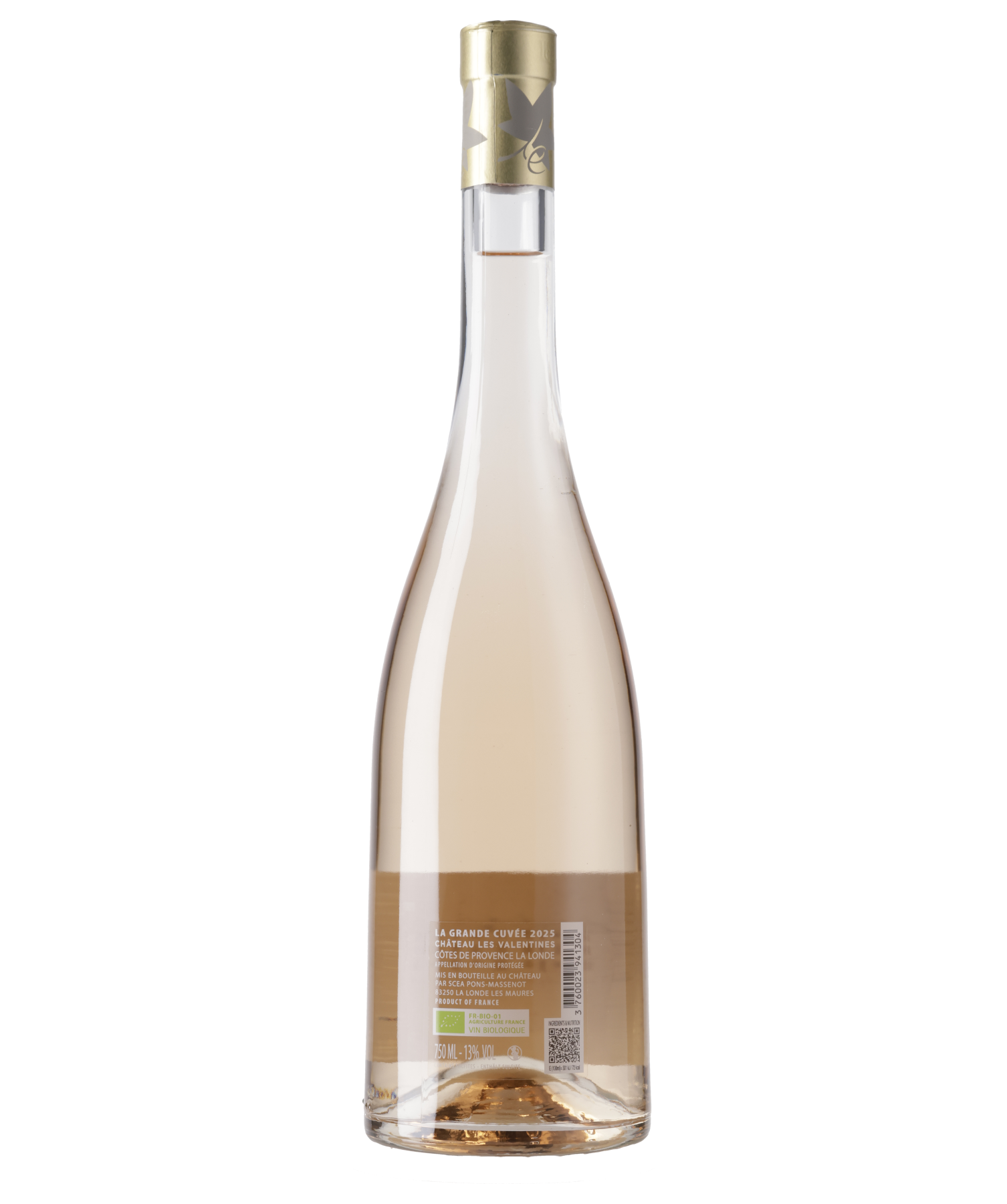
AOC Côtes de Provence, Château Les Valentines, 750 ml


Description
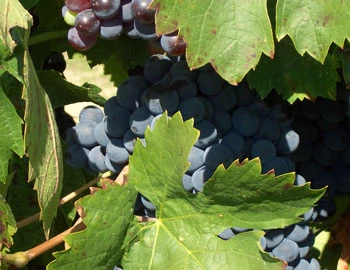
Exciting masterpiece of Provence from over 80-year-old vines. This ingenious "Grande Cuvée" rosé combines carefully selected Mourvèdre, Cinsault and a small proportion of Grenache grapes from the oldest vines to create a true gem. The fragrance of red berries and white flowers rises delicately to the nose. The rosé is juicy on the palate, with complex flavours reminiscent of pink grapefruit, lemon zest and Provençal spices. Mineral notes paired with the diverse flavours make this Grande Cuvée a full-bodied rosé; with an elegant freshness and an aromatic, balanced finish.
Attributes
| Grape variety: | Cinsault, Mourvèdre, Grenache |
| Producer: | Château Les Valentines |
| Origin: | France / Provence / Côtes de Provence |
| Label: | Certified organic or biodynamic wine |
| Ripening potential: | 2 to 6 years |
| Drinking temperature: | 10 to 12 °C |
| Food Pairing: | Mild Asian dishes, Grilled fish, Giant crevettes, grilled langoustines, Wild fowl, Mussels au gratin |
| Vinification: | fermentation at low temperatures, (short) pellicular fermentation |
| Harvest: | strict selection |
| Volume: | 13.0 % |
| Note: | Contains sulphites |
Mourvèdre
Hot-blooded Spaniard
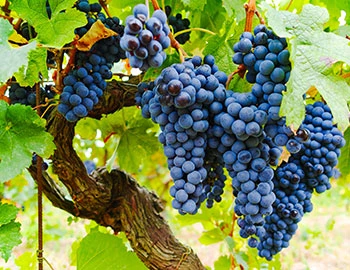
It cannot be hot enough for the Monastrell grape. It grows around the Mediterranean, where the summers are long and hot and the winters mild. At only 200 metres in elevation, or 80 kilometres from the coast, its grapes have problems ripening. It was likely born in the Valencia region. According to written records, it was already counted among the most important varieties in 1460. Its exact origin is thought to be the Camp de Morvedre area. From there, it migrated in the 17th century to Provence, where it was christened Mourvèdre. Its wines are deeply dark, with intense blackberry aromas, rich tannins and moderate acidity. They enter into the most beautiful harmonies with other varieties from the south, such as Garnacha, Carignan or Syrah. The Mourvèdre is the main ingredient of red wines of Bandol; it also flows into the Châteauneuf-du-Pape. On the Spanish Levante coast, it is also pressed solo.
Mourvèdre
Hot-blooded Spaniard
It cannot be hot enough for the Monastrell grape. It grows around the Mediterranean, where the summers are long and hot and the winters mild. At only 200 metres in elevation, or 80 kilometres from the coast, its grapes have problems ripening. It was likely born in the Valencia region. According to written records, it was already counted among the most important varieties in 1460. Its exact origin is thought to be the Camp de Morvedre area. From there, it migrated in the 17th century to Provence, where it was christened Mourvèdre. Its wines are deeply dark, with intense blackberry aromas, rich tannins and moderate acidity. They enter into the most beautiful harmonies with other varieties from the south, such as Garnacha, Carignan or Syrah. The Mourvèdre is the main ingredient of red wines of Bandol; it also flows into the Châteauneuf-du-Pape. On the Spanish Levante coast, it is also pressed solo.
Cinsault
Sun in a glass
The southern French Cinsault, also written Cinsaut, is a curiosity among the grape varieties. It belongs to the so-called “dyer grapes”. These are red grapes in which the pigments sit not only in the skins but also in the flesh. That means, when the Cinsault is pressed, pink juice results, rather than the white you see from other grapes. Previously, the Cinsault was used to spice up lighter-coloured Burgundy. But now it has become emancipated. With a soft, fruity style, seductive raspberry and strawberry aromas and good aging potential, it mixes with the most renowned growths from the southern Rhône, around the Châteauneuf-du-Pape. Solo, it yields wonderfully aromatic rosés.
France
France – Philosophy in a bottle
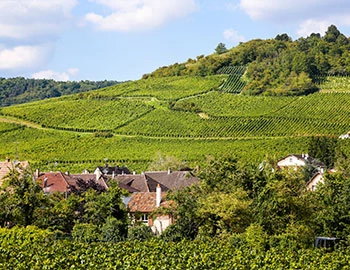
According to French philosophy, wine should be an expression of the soil and climate. They use the word “terroir” to describe this. Terroir makes every wine different, and many especially good. French wine is regarded worldwide as an expression of cultural perfection. The French believe that humans are responsible for the quality of the berries, the vine variety for their character, and nature for the quantity. This philosophy can be expressed succinctly as: “the truth is the vineyard, not the man.”