

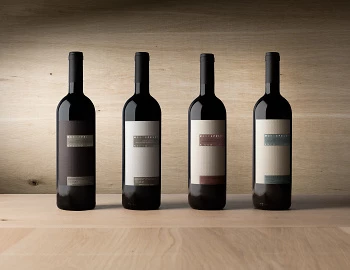
Mille Rosé 2024
IGT Toscana, Montepeloso, 750 ml


Description
Tuscan love story
Montepeloso in Tuscany is synonymous with excellent winemaking and this is clearly evident in the Mille Rosé, which is made from 100% Sangiovese grapes.
You can almost smell the herbs of Tuscany. There is also cherry and red berries, fine tannins and a discreet mineral note with a hint of mint, which gives this culinary companion its freshness.
Surprising with Indian curries. A «thirst quencher» with spicy barbecues. And top with melon and grilled courgettes.
Attributes
| Grape variety: | Sangiovese |
| Producer: | Montepeloso |
| Origin: | Italy / Toscana |
| Ripening potential: | 1 to 5 years |
| Drinking temperature: | 16 to 18 °C |
| Food Pairing: | Italian antipasti, Spiced grillades, Mild Asian dishes, Salad with vegetables, pulses, pasta |
| Vinification: | long must fermentation, fermentation of entire grape, partly destemmed, fermentation in wooden barrel |
| Harvest: | hand-picking, in small boxes |
| Maturation: | in steel tank, in partly new and used barriques/ Pièces |
| Bottling: | filtration |
| Maturation duration: | 6 months |
| Volume: | 12.5 % |
| Note: | Contains sulphites |
Montepeloso
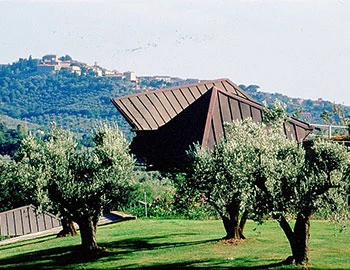
The Montepeloso winery, located in Maremma, owned by Swiss co-proprietor and estate manager Fabio Chiarelotto, has earned a reputation for outstanding red wines. With a combination of mostly traditional and indigenous grape varieties, but also international varieties such as Cabernet Sauvignon, complex wines with a Mediterranean character are produced. This Tuscan gem is hidden in the hills of Suvereto, near the Tyrrhenian coast — one of the hottest areas of Tuscany.
Montepeloso spans 30 hectares, of which 15 are planted with vines. The terroir in the valley near Suvereto, around four kilometres from the Tyrrhenian coast, between the fertile alluvial soil in the plain and the barren valley flanks, offers the vines exciting conditions. Here, in one of the hottest areas of Tuscany, land and sea alternate. The thermals and coastal winds caused by the strong sunlight and the nature of the soil have a welcome cooling effect on the grapes. This keeps them fresh despite the Tuscan sun, which is reflected not least in the pronounced salinity of the wines. The highly mineral soils of the Colline Metallifere and the spicy notes of the Mediterranean scrub characterise the wines, giving them an unmistakable character of origin. The wines of Montepeloso are known for their power, but also for their elegance, structure and finesse, which makes them sought-after representatives of the Tuscan wine tradition.
Sangiovese
Epitome of Tuscany
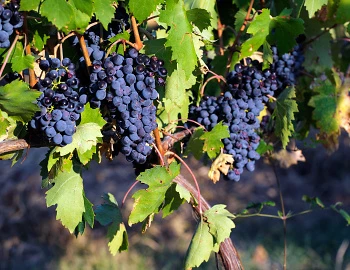
Sangiovese is Italy’s most important red grape variety and one of the most defining of the Italian wine landscape. Its origins likely date back to Etruscan times. For centuries, Sangiovese has been rooted in Tuscany, where it shapes renowned wine regions such as the Chianti area around Siena and Florence – forming the basis of world-famous wines. Today, the variety is widespread far beyond Tuscany across many regions of central and southern Italy, including Romagna, Umbria and Le Marche, and appears under different names and expressions depending on its origin, such as Brunello, Prugnolo Gentile or Morellino.The grape shows remarkable adaptability while being highly sensitive to site and climate. Even small differences in soil, altitude or microclimate, as well as berry and clonal variations, result in distinctly different wine styles. Aromatically, it is dominated by juicy cherries, red berries and plums, complemented by violets, herbs and subtle spice, often developing earthy notes with age. It is also characterised by vibrant acidity and firm, fine-grained tannins, giving the wines structure, freshness and excellent ageing potential.
Italy
Italy – Where wine is a way of life
The Italian wine regions are extremely diverse, and this is made clear in their wines. Established varieties such as Merlot, Syrah, and Sauvignon can be found on just 15 percent of the total vine growing area. The remaining 85 percent is reserved for autochthonous, indigenous varieties. More than 2,000 different grape varieties are grown under diverse conditions and pressed with various techniques into wines that reach the top tier of the international wine market.