
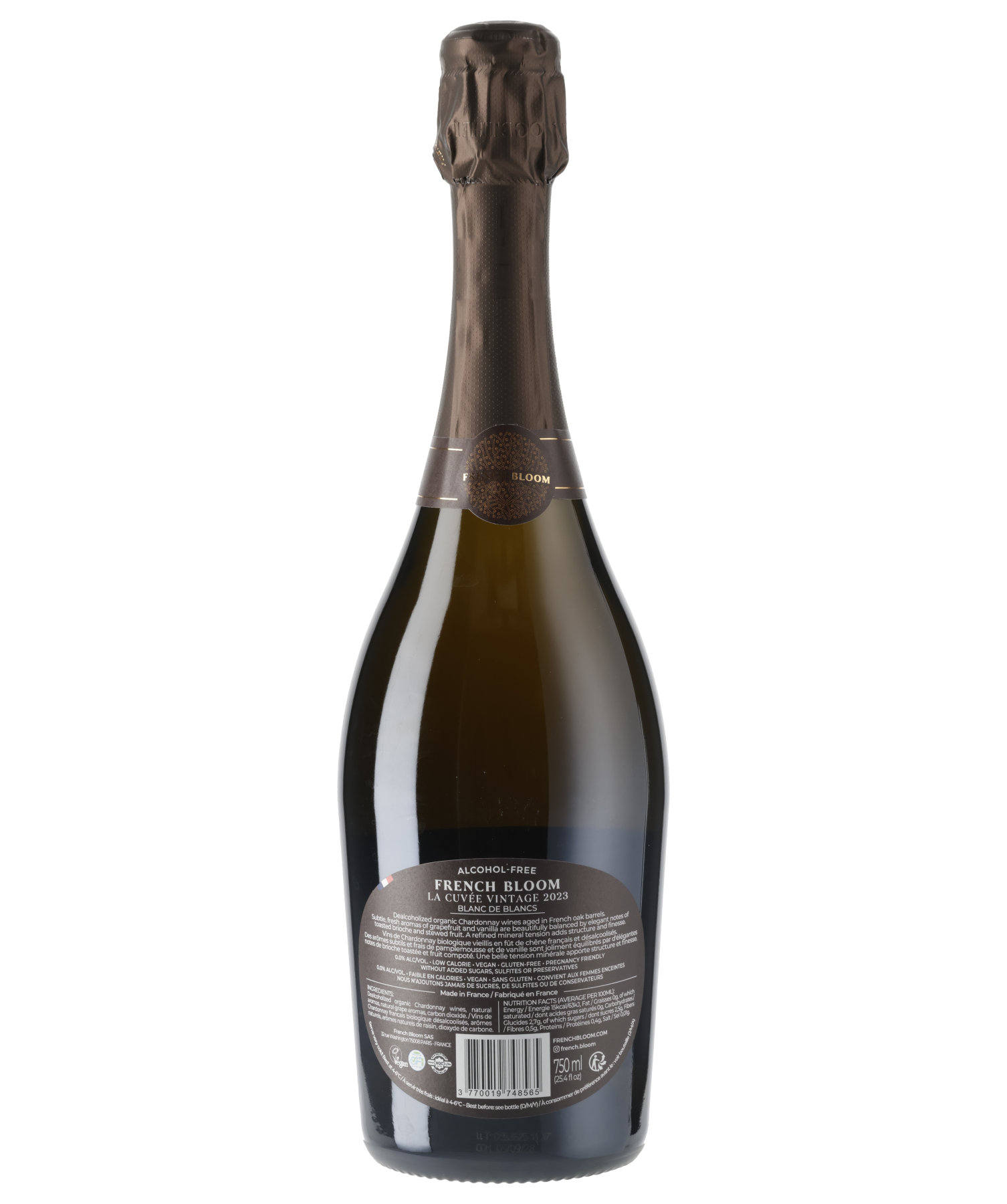

French Bloom La Cuvée Vintage, Blanc de Blancs 2023
Frankreich, French Bloom, 750 ml


Refinement, elegance and freshness – alcohol-free
- Finesse and freshness – an alcohol-free sparkling wine full of elegance and excitement.
- Lively on the nose, harmonious yet expressive on the palate, elegant right through to the finish.
- Versatile enjoyment – goes well with aperitifs, brunch or even festive meals. The perfect alternative for fans of Blanc de Blancs.
Description
An exceptional non-alcoholic vintage sparkling wine from France, offering a special taste experience with 0.0% alcohol. Delicate, fresh and elegant, it proves that structure, tension and finesse are possible even without alcohol. Lively and expressive on the nose, with grapefruit, delicate vanilla notes and a hint of toasted brioche. Harmonious on the palate, it combines the freshness of citrus fruits with gentle compote aromas. A refined mineral structure gives it depth, while notes of toast and brioche round off the finish. A versatile accompaniment to food: pairs well with chicken in a light mushroom cream sauce, creamy risotto or grilled vegetables. A wonderful alcohol-free alternative for fans of a «Blanc de Blancs».
Dealcoholized organic Chardonnay wines, natural aroma, natural grape aromas, carbon dioxide. Suitable for pregnant or breastfeeding women.
Nutritional information (100 ml): Energy 15 kcal / 63 KJ, carbohydrates 2,7g, of which sugar 2,5g, fibers 0,5g, proteins 0,4g, fats 0,g, saturated fats 0g, salt 0.01g
Tasting – The Art of Wine Selection at the Baur au Lac

Meet over 20 wine and spirits producers, benefit from attractive special offers, and attend exclusive masterclasses featuring aged wines. Limited places available.
Sunday, November 15, 2026 | 2.00 pm until 7.00 pm
Monday, November 16, 2026 | 2.00 pm until 8.00 pm
Attributes
| Grape variety: | Chardonnay |
| Producer: | French Bloom |
| Origin: | France / Languedoc-Roussillon / Limoux |
| Label: | Vegan |
| Drinking temperature: | 6 to 8 °C |
| Volume: | 0.0 % |
| Note: | Contains sulphites |
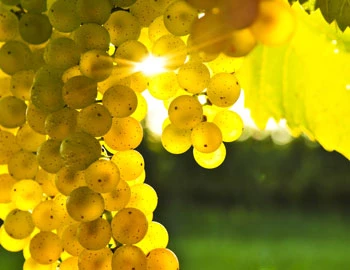
Chardonnay
King or beggar?
Hardly any variety of vine shows such a broad spectrum of quality as the Chardonnay. Its wines range from faceless neutrality to breath-taking class. It is an extremely low-maintenance vine, which explains why it is grown around the world – even in places where it probably should not be. The aromas of the Chardonnay variety are not very pronounced: a bit of green apple, a little hazelnut; in warmer latitudes, also melon and exotic fruits. The wines are often defined by maturing in casks. They develop more or less subtle notes of butter, toasted bread and vanilla. The grapes achieve their highest expression in their region of origin, Burgundy. Its heart beats in the Côte de Beaune: one might think of the plant growth of Meursault or Puligny-Montrachet. With their finesse and complexity, they can survive for decades. Chardonnay also achieves first class in some Blanc-de-Blancs champagnes. It additionally yields great wines in the Burgundian Chablis, and increasingly in Australia and Chile. A simple rule of thumb for pairing with food: When butter and cream are involved, you cannot go wrong with Chardonnay.
Languedoc-Roussillon
Languedoc and Roussillon: the wine-giant of the south
The largest contiguous wine region of France begins on the west bank of the Rhône River, stretching more than 240 kilometres to the west to Banyuls-sur-Mer, on the border with Spain. The area is an inexhaustible reservoir of corpulent wines from international varieties, but the top crus from this region come from various regional appellations, where long-established varieties such as Carignan and Grenache (red) and Picpoul and Bourboulenc (white) yield extraordinarily characterful wines.
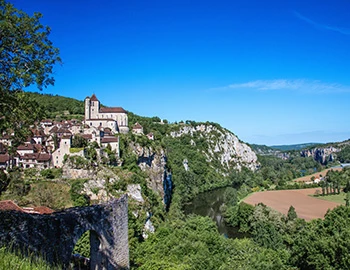
France
France – Philosophy in a bottle
According to French philosophy, wine should be an expression of the soil and climate. They use the word “terroir” to describe this. Terroir makes every wine different, and many especially good. French wine is regarded worldwide as an expression of cultural perfection. The French believe that humans are responsible for the quality of the berries, the vine variety for their character, and nature for the quantity. This philosophy can be expressed succinctly as: “the truth is the vineyard, not the man.”