

Château Fieuzal blanc 2025
AC Pessac-Léognan, 750 ml
Description
Citing Robert Parker The Wine Advocate "...One of the more compelling white wines in Bordeaux in recent years, the 2025 Blanc from Château de Fieuzal unfurls in the glass with an attractive bouquet of pear, white peach, spice, flowers and ripe orchard fruits. Medium- to full-bodied, layered and dense, it’s built around a fleshy, seamless core of fruit, framed by racy acidity that carries through to a long, mineral and precise finish. It's a particularly successful rendition and among the more complete whites of the vintage..."
Attributes
| Grape variety: | Sauvignon Blanc, Sémillon |
| Producer: | Château Fieuzal |
| Origin: | France / Bordeaux / Péssac-Léognan |
| Drinking temperature: | 10 to 12 °C |
| Volume: | 13.5 % |
| Note: | Contains sulphites |
Sémillon
The fungi be thanked
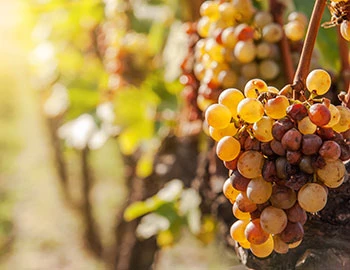
The Sémillon grape is the basis of the legendary sweet wines of Sauternes. Its origins are there, in the southern part of the Bordeaux region. Its secret to success is its susceptibility to the Botrytis fungus, which pierces the skin of the ripe berries. Thus the water evaporates, and the sugar in the fruits concentrates. The musts are as thick as syrup. They present the citrus-fresh, fruity aromas of the Sémillon varieties. In addition, the Botrytis fungus contributes complex notes of honey, dry apricot and candied orange to the wine. The Sémillon is closely related to the Sauvignon blanc, and almost all sweet wines from Sauternes and its surroundings contain a small proportion of Sauvignon. The dry whites from Bordeaux are the opposite: the Sémillon mostly plays the supporting role. In early-19-century South Africa, Sémillon was the most planted grape. However, only vanishingly small quantities still grow there today. However, the vine has since taken root in California and Australia.
Péssac-Léognan
Pessac-Léognan: top crus from the suburbs
Pessac-Léognan is a communal appellation (following the example of the village appellations in the Médoc) located in the northernmost part of the Graves region. Its immediate proximity to the city of Bordeaux has drastically altered the area in recent years. Many chateaux have had to yield to settlement pressures. For this reason, some of the very best Bordeaux terroirs are located in the new suburbs. Top crus are produced on deep gravel soils, which combine the greatest possible elegance and power in the best Bordeaux style.
Bordeaux
Bordeaux: high prestige, high quality
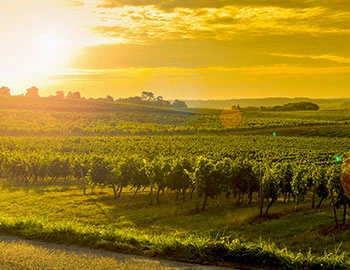
With a total area of around 115,000 hectares, Bordeaux may not be France’s largest wine-growing region, but it is certainly its most prestigious. The range of wines produced here today is enormous: ranging from red everyday wines with a great relationship between price and quality to exclusive, and accordingly expensive, premier crus. Elegant white wines and noble sweet specialties round out the spectrum.
France
France – Philosophy in a bottle
According to French philosophy, wine should be an expression of the soil and climate. They use the word “terroir” to describe this. Terroir makes every wine different, and many especially good. French wine is regarded worldwide as an expression of cultural perfection. The French believe that humans are responsible for the quality of the berries, the vine variety for their character, and nature for the quantity. This philosophy can be expressed succinctly as: “the truth is the vineyard, not the man.”