
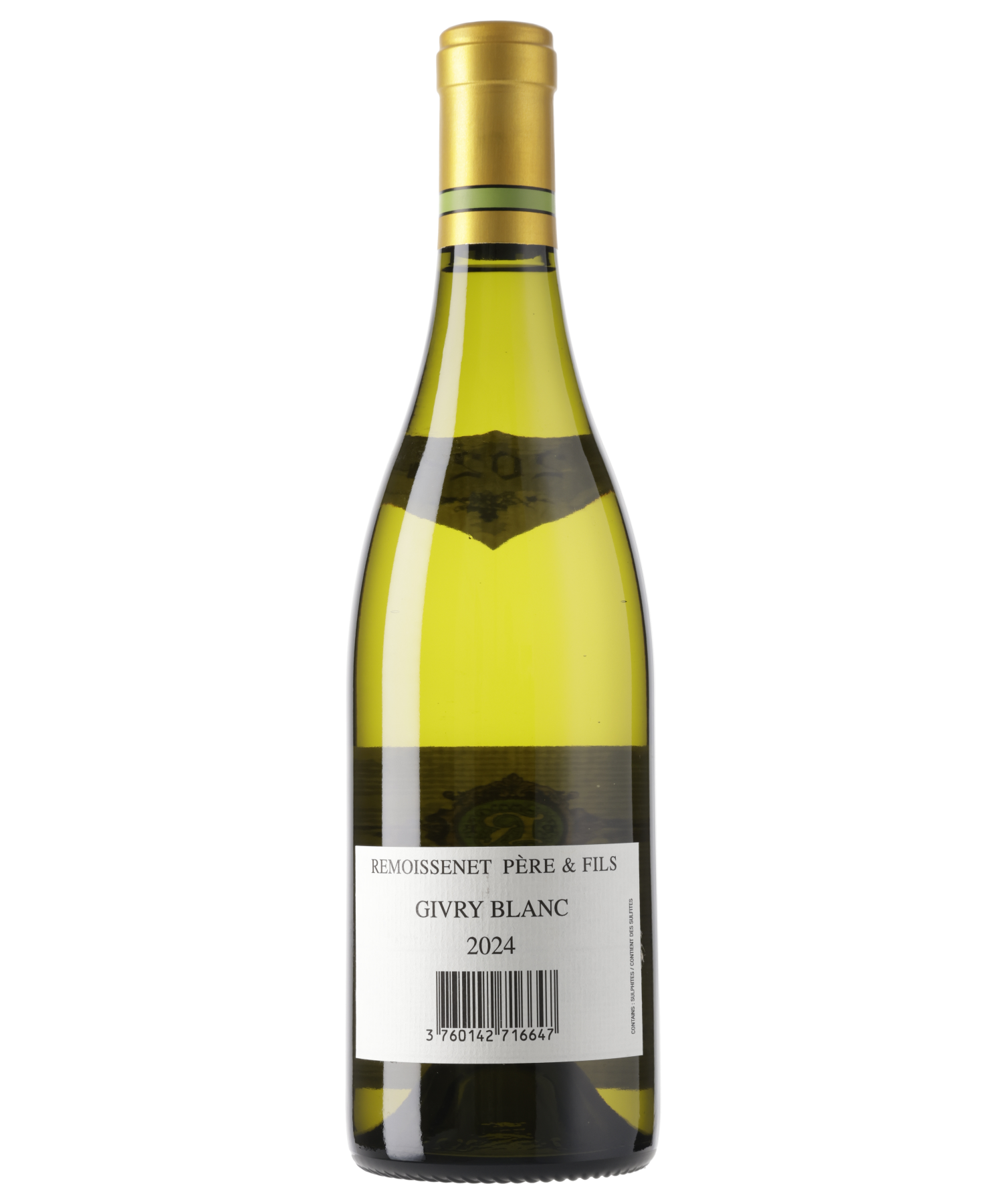
Givry blanc 2024
AC, Remoissenet, 750 ml


A relaxed Burgundy
- The charming side of Burgundy; Chardonnay from the heart of the Côte Chalonnaise.
- Delicate fruit and subtle roasted notes; harmonious and pleasantly creamy.
- From aperitifs to mild curries, it’s a surprisingly versatile accompaniment.
Description
With this Givry Blanc from the heart of the Côte Chalonnaise, Remoissenet showcases the charming side of Burgundy. On the nose, blossom honey and citrus fruits blend with hints of lilies and dried apricots. As the wine matures, subtle toasted notes emerge, lending it additional character. On the palate, it is soft and harmonious, with a pleasant creaminess and perfectly integrated acidity. A Chardonnay that effortlessly combines pleasure and finesse. It pairs well not only as an aperitif, but also with fish or white meat in butter or cream sauces, tangy hard cheeses, quiches and puff pastry creations. It even pairs surprisingly well with mild curry dishes.
Wines for Autumn's Golden Days

Perfect for autumn cuisine and cosy moments: benefit from a 15% price advantage on our autumn wine selection until 31 October 2026, whilst stocks last.
Tasting – The Art of Wine Selection at the Baur au Lac

Meet over 20 wine and spirits producers, benefit from attractive special offers, and attend exclusive masterclasses featuring aged wines. Limited places available.
Sunday, November 15, 2026 | 2.00 pm until 7.00 pm
Monday, November 16, 2026 | 2.00 pm until 8.00 pm
Attributes
| Grape variety: | Chardonnay |
| Producer: | Remoissenet Père & Fils |
| Origin: | France / Bourgogne / Côte Chalonnaise |
| Ripening potential: | 2 to 8 years |
| Drinking temperature: | 10 to 12 °C |
| Food Pairing: | Vegetable pie, Whitefish fillets à la meunière, Fish ragout with saffron sauce, Risotto ai frutti di mare, Mushroom ragout |
| Harvest: | hand-picking, strict selection, in small boxes |
| Maturation: | in partly new and used barriques/ Pièces |
| Maturation duration: | 12 months |
| Volume: | 13.5 % |
| Note: | Contains sulphites |
Remoissenet Père & Fils
Prestigious terroirs, work in micro-parcels, a distinctive style, exceptional quality right from the entry level... Remoissenet Père et Fils stands out for many things, and everything makes you want to taste these wines! Wines for the moment - or for eternity.
Founded in 1879 as a classic négociant in Beaune, Remoissenet Père et Fils today also holds 25 hectares of vineyards, some owned and some leased. In addition, it has access to some exceptional grapes from renowned winegrowers they are friends with. But whatever the source, the team around Pierre-Antoine Rovani and oenologist Claudie Jobard demand the highest quality for each and every wine. The grapes are given an extended time to ripen, until they develop the unmistakable power and complexity that distinguish a Remoissenet. Wood is essential, but never an end in itself. Both white and red wines are fermented and aged in barrels, usually 350 litres. New oak is perfectly adapted to each wine. It's the terroir and the grape variety that set the tone: intense, deep and very enticing, from Gevrey-Chambertin to Beaune, Meursault, Montrachet or Givry in Côte Chalonnaise.
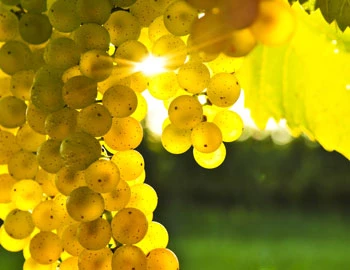
Chardonnay
King or beggar?
Hardly any variety of vine shows such a broad spectrum of quality as the Chardonnay. Its wines range from faceless neutrality to breath-taking class. It is an extremely low-maintenance vine, which explains why it is grown around the world – even in places where it probably should not be. The aromas of the Chardonnay variety are not very pronounced: a bit of green apple, a little hazelnut; in warmer latitudes, also melon and exotic fruits. The wines are often defined by maturing in casks. They develop more or less subtle notes of butter, toasted bread and vanilla. The grapes achieve their highest expression in their region of origin, Burgundy. Its heart beats in the Côte de Beaune: one might think of the plant growth of Meursault or Puligny-Montrachet. With their finesse and complexity, they can survive for decades. Chardonnay also achieves first class in some Blanc-de-Blancs champagnes. It additionally yields great wines in the Burgundian Chablis, and increasingly in Australia and Chile. A simple rule of thumb for pairing with food: When butter and cream are involved, you cannot go wrong with Chardonnay.
Côte Chalonnaise
Côte Chalonnaise: sincere crus with character
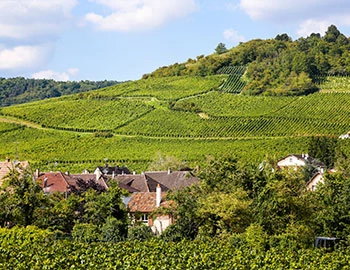
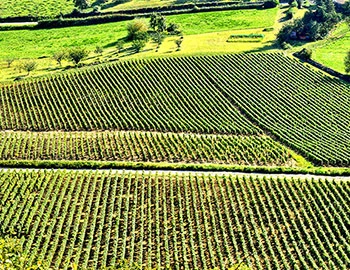
The Côte Chalonnaise is located west of the city of Chalon-sur-Saône, and connects with the Côte de Beaune region to the south. Even far from the prestigious top sites, Chardonnays and Pinots originate here which embody the best of the Burgundian characteristics, even if they do not have the fullness and complexity of premium wines from Beaune. They are sincere wines that, with their edges and corners, are ideal for pairing with food. The refreshing Crémant de Bourgogne is a particular specialty of this region.
Bourgogne
Burgundy: home of the crus
Burgundy and Bordeaux are France’s most prestigious wine regions. Nonetheless, they are completely distinct in character: while Bordeaux, as the land of the chateaux, enjoys an aristocratic image, Burgundy has retained its rustic agrarian structure. Burgundy stretches for over 200 kilometres, from Dijon in the north to Lyon in the south. In a highly complex jigsaw of the most diverse of terroirs, Chardonnay and Pinot Noir demonstrate the subtle ways in which they embody their sources.
France
France – Philosophy in a bottle
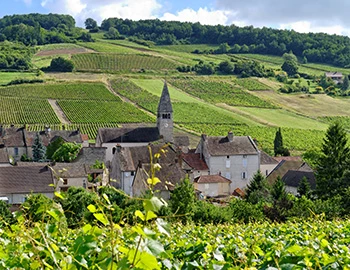
According to French philosophy, wine should be an expression of the soil and climate. They use the word “terroir” to describe this. Terroir makes every wine different, and many especially good. French wine is regarded worldwide as an expression of cultural perfection. The French believe that humans are responsible for the quality of the berries, the vine variety for their character, and nature for the quantity. This philosophy can be expressed succinctly as: “the truth is the vineyard, not the man.”