
Chardonnay 2022
AOC Graubünden, Weingut Familie Hansruedi Adank, 750 ml


Description
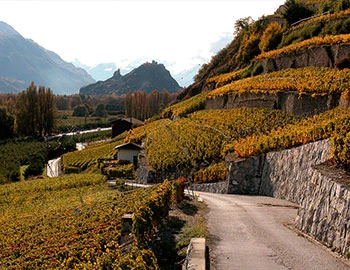
This picture-book Chardonnay from Fläsch is created by the Adank family according the Chablis model. The grapes of the Burgundy vines are harvested early to give this wine a certain freshness. Already in the nose you can recognize the grape variety! A multi-layered bouquet unfolds aromas of delicate vanilla, ripe bosco apple and pear and discreetly toasted hazelnut notes. On the palate this Chardonnay stands out with dense aromas of ripe yellow stone fruits and sweet-tart lime. The toasted aromas (of lightly toasted French pièce) and the juicy acidity are very well integrated. The long finish is mineral and powerful. A very balanced, exciting Chardonnay from the Bündner Herrschaft.
Attributes
| Grape variety: | Chardonnay |
| Producer: | Hansruedi Adank |
| Origin: | Switzerland / Ostschweiz / Graubünden |
| Other vintages: | 2024 |
| Label: | Vegan |
| Ripening potential: | 1 to 8 years |
| Drinking temperature: | 10 to 14 °C |
| Food Pairing: | Calamari alla romana, Fresh water fish with cream sauce, Crispy roast chicken, Coquilles Saint Jacques on lentils, Fish ragout with saffron sauce |
| Vinification: | fermentation in steel tank, long must fermentation, fermentation at low temperatures |
| Harvest: | hand-picking |
| Maturation: | in partly new and used barriques/ Pièces, long cultivation |
| Bottling: | filtration |
| Maturation duration: | 12 months |
| Volume: | 13.5 % |
| Note: | Contains sulphites |
Chardonnay
King or beggar?
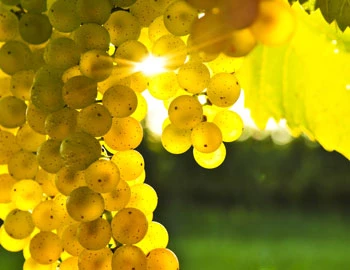
Hardly any variety of vine shows such a broad spectrum of quality as the Chardonnay. Its wines range from faceless neutrality to breath-taking class. It is an extremely low-maintenance vine, which explains why it is grown around the world – even in places where it probably should not be. The aromas of the Chardonnay variety are not very pronounced: a bit of green apple, a little hazelnut; in warmer latitudes, also melon and exotic fruits. The wines are often defined by maturing in casks. They develop more or less subtle notes of butter, toasted bread and vanilla. The grapes achieve their highest expression in their region of origin, Burgundy. Its heart beats in the Côte de Beaune: one might think of the plant growth of Meursault or Puligny-Montrachet. With their finesse and complexity, they can survive for decades. Chardonnay also achieves first class in some Blanc-de-Blancs champagnes. It additionally yields great wines in the Burgundian Chablis, and increasingly in Australia and Chile. A simple rule of thumb for pairing with food: When butter and cream are involved, you cannot go wrong with Chardonnay.
Graubünden
Graubünden: Mecca for Burgundy varieties
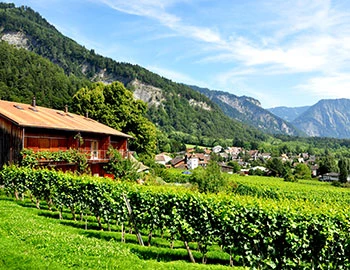
Nowhere in Switzerland has a better ratio of first-class Pinot noir crops to cultivation area than Graubünden. The ageing philosophy of vintners here leaves its imprint even more than the subtle differences in terroir from one vineyard village to the next. In recent years, three Pinot types have established themselves here: the light and sweet Herrschäftler for everyday drinking, the selections aged in large wooden barrels or used barriques, and of course the premium selections of individual estates matured in barriques.
Ostschweiz
Eastern Switzerland: an intriguing puzzle
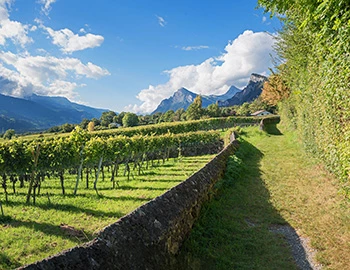
Eastern Switzerland has long been positioned on the northern rim of the climate zone where the cultivation of popular Swiss varieties is possible. Due to a warming climate, the vineyards of Aargau, Zurich, Schaffhausen, Thurgau and Graubünden are now in the zone where varieties such as Müller-Thurgau or Pinot Noir succeed excellently. But even long-established, almost-forgotten varieties such as Elbling, Räuschling and Completer are experiencing a renaissance.
Switzerland
Switzerland – A small country with enormous diversity
Switzerland is famous for its banks, watches, and cheese, but not necessarily for its wine. The Swiss didn't invent wine, but they have been extremely open and curious to it. Wine culture arrived in what is now modern Switzerland via several routes: from Marseilles to Lake Geneva and the Lower Valais region; from the Aosta Valley through the Great St. Bernard Pass to the rest of Valais; from the Rhone through Burgundy, across the Jura Mountains to Lake Constance; and from Lombardy to Ticino, and then on to Grisons.