
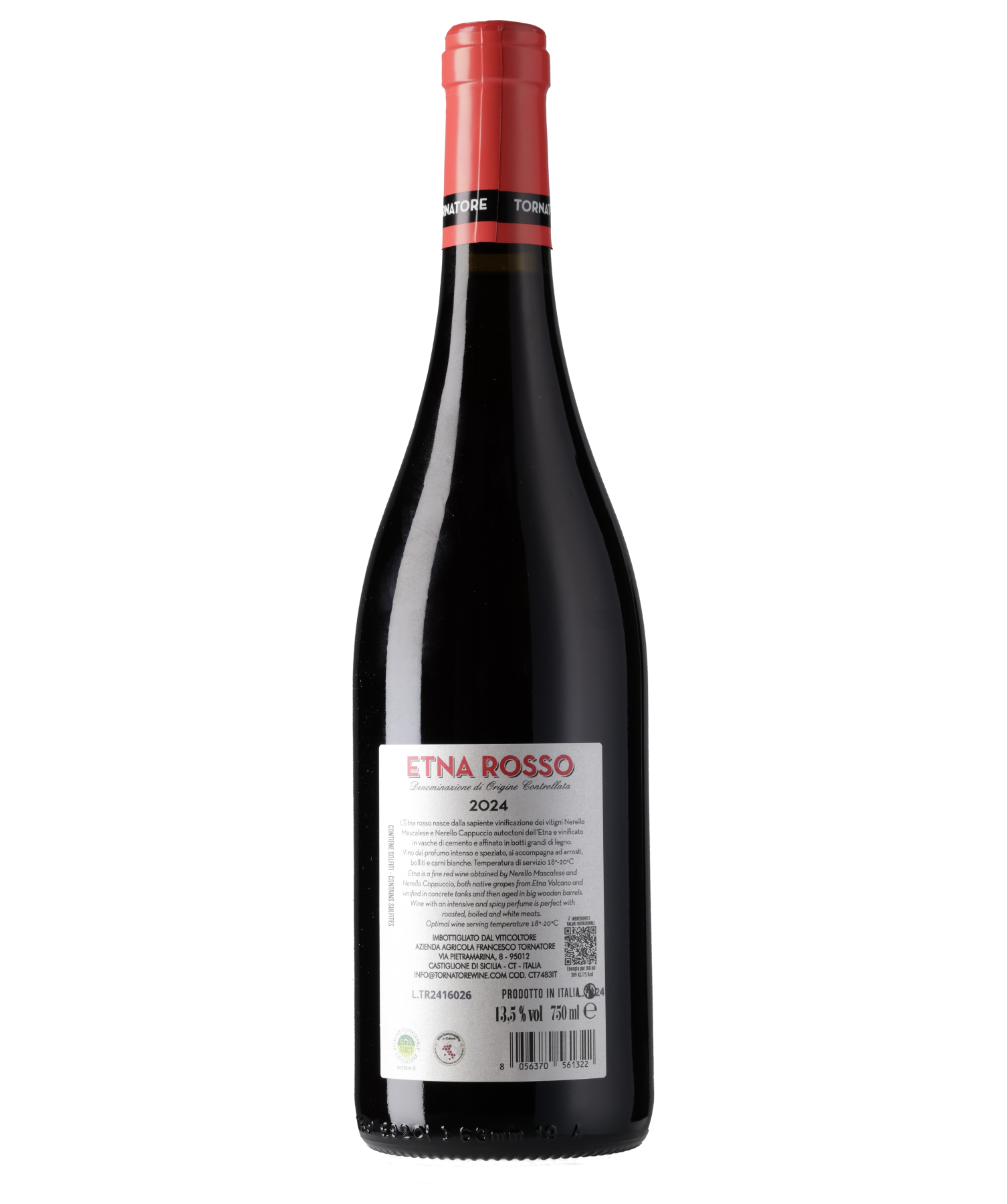
Etna Rosso 2024
DOC Etna, Tornatore, 750 ml


Between Lava and High Altitudes
- From the northern slopes of Mount Etna: volcanic soils and altitude define its character.
- Wild berries and cherries combine with freshness, subtle minerality and an elegant structure.
- Perfect with antipasti, mushroom dishes, grilled tuna steak or rack of lamb with herbs.
Description
On the northern slopes of Mount Etna, around Castiglione di Sicilia, this Etna Rosso finds ideal conditions. Volcanic soils and cool altitudes lend it freshness, precision and a distinctive mineral character. The nose reveals wild berries and ripe cherries. Juicy and elegant on the palate, Nerello Mascalese brings structure and finesse, whilst Nerello Cappuccio harmoniously rounds off the blend. Well-integrated tannins and a long finish emphasise the elegance and provenance of this Etna Rosso. Ideal with porcini mushroom risotto, pasta with fried mushrooms, antipasti featuring salami, prosciutto and pecorino, as well as grilled tuna or lamb with Mediterranean herbs.
Attributes
| Grape variety: | Nerello Mascalese, Nerello Cappuccio |
| Producer: | Tornatore |
| Origin: | Italy / Sicilia / Etna |
| Label: | Vegan |
| Ripening potential: | 7 years |
| Drinking temperature: | 16 to 18 °C |
| Food Pairing: | Cold fish dish, dried meat, Risotto with ceps, Orecchiette, Strozzapreti alla siciliana, Saddle of lamb fillet with herb jus, Wild fowl |
| Vinification: | fully destemmed, short must fermentation, fermentation in cement tank, fermentation in steel tank, Pumping over, Punching down, fining |
| Harvest: | selecting the grapes (by hand), hand-picking, in small boxes, strict selection |
| Maturation: | partly in concrete tank, partly in wooden barrel/foudre, partly in steel tank |
| Bottling: | filtration |
| Maturation duration: | 6 months |
| Volume: | 13.5 % |
| Note: | Contains sulphites |
Tornatore
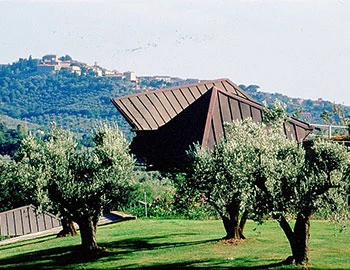
Some of Sicily’s most exciting wines are produced on the northern slopes of Mount Etna. Nestled amongst lava flows and high-altitude vineyards, the Tornatore family has been shaping the region’s wine-growing tradition for generations. Their wines combine Sicilian warmth with freshness, precision and the volcano’s characteristic minerality.
The Tornatore name has been firmly established on Mount Etna since 1865. What began as a few vines on the fertile volcanic slopes has, over the generations, developed into one of the region’s most influential wineries. A key milestone was set by grandfather Giuseppe, who built a traditional palmento – a historic wine press – in 1910, thereby laying the foundations for the further development of the family business. Today, Francesco Tornatore carries on this legacy, combining traditional knowledge with a modern approach to quality.
Tornatore is one of the leading producers of Etna DOC wines and cultivates around 100 hectares of land. The focus is on the traditional and indigenous grape varieties Carricante, Nerello Mascalese and Nerello Cappuccio, which authentically reflect their origins. Modern winemaking techniques combined with a deep respect for nature result in wines with an unmistakable character. As one of Italy’s most renowned estates, Tornatore’s wines are regularly honoured by leading wine critics, including multiple awards of the coveted «Tre Bicchieri» (3 glasses) from Gambero Rosso.
Sicilia
Sicily: more than a wine island
The largest island in the Mediterranean has a greater variety and history of wine to offer than many wine-growing countries. The focus of this interest rests on the full, fruity, yet well-structured wines from the long-neglected red Nero d'Avola variety, and on the wholesome Catarratto white wines. In addition, two legendary wines are experiencing a well-deserved renaissance: the liqueur wines from Marsala and the growths from Mount Etna, with their impressive crispness and complexity.
Italy
Italy – Where wine is a way of life
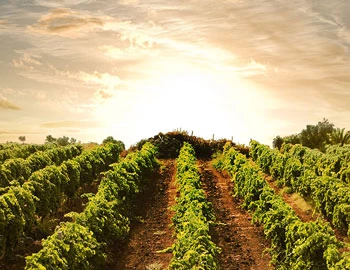
The Italian wine regions are extremely diverse, and this is made clear in their wines. Established varieties such as Merlot, Syrah, and Sauvignon can be found on just 15 percent of the total vine growing area. The remaining 85 percent is reserved for autochthonous, indigenous varieties. More than 2,000 different grape varieties are grown under diverse conditions and pressed with various techniques into wines that reach the top tier of the international wine market.