

Saboteur Red 2018
WO Luddite, Luddite Wines, 750 ml


Description
The fragrance of ripe dark and red fruits, spices and garrigue herbs is underscored by floral, perfume-like accents and underpinned by fine roasting aromas. Juicy, with an intense, spicy and fruity taste, it spreads on the palate and has a fresh and balanced effect with pleasantly firm tannins.
Attributes
| Grape variety: | Grenache, Shiraz, Cabernet Sauvignon, Mourvèdre |
| Producer: | Luddite Wines / Fam. Verburg & Meyer |
| Origin: | South Africa / Coastal Region / Bot River |
| Other vintages: | 2020 |
| Ripening potential: | 4 to 10 years |
| Drinking temperature: | 16 to 18 °C |
| Food Pairing: | Spiced grillades, Wild specialities, Bistecca fiorentina, T-Bone steak |
| Vinification: | fermentation at low temperatures, fermentation in steel tank, Pumping over, cooling period |
| Harvest: | hand-picking |
| Maturation: | in partly new and used barriques/ Pièces |
| Bottling: | filtration |
| Maturation duration: | 12 months |
| Volume: | 14.5 % |
| Note: | Contains sulphites |
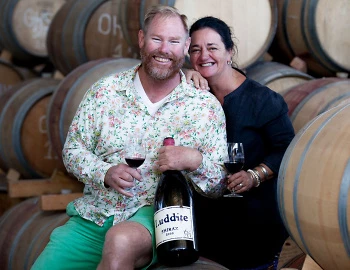
Luddite Wines / Fam. Verburg & Meyer
Niels Verburg is one of those people who you immediately want to befriend. With his imposing stature and beaming smile, he stands out and magically draws people in.
At an early age, while he was working in Australia, he realised that Shiraz was "his" grape. In Chile, he later found the inspiration for the way he wanted to make his wine.
Together with his wife Penny, he planted his first vines in 1996. The first vintage was pressed in 2000. The small winery with just 6 hectares of vines is located just outside the village of Bot River. Walker Bay is only 30 kilometres away. The mild Mediterranean climate from the nearby ocean gives the vines on the south-western slopes of the Houw Hoek mountains a slow and long growing period. This results in spicy Shiraz with elegant fruit sweetness.
The name of the vineyard refers to the Luddites, 19th century English textile workers who fought against the Industrial Revolution. Consequently, Niels is rather reluctant to use "technology", as he says in a humorous way, both when caring for the vineyards and working in the cellar. Vinification involves as little intervention as possible, if any.
Niels and Penny have fulfilled their dream. In addition to the vines, there are also some olive trees and a few lucky pigs are reared: a rural idyll in South Africa. They epitomize the great change occurring in South Africa since the 1990s: moving away from mass production and towards independent quality wines that do not fear comparison with top international wines.
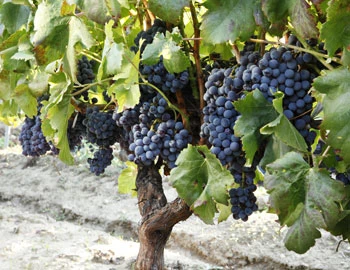
Grenache
Grenache seldom comes alone
Spaniards and Sardinians make the Grenache contentious: both claim it originated from their country. In fact, it had already appeared in both places by the 16th century. But a large number of mutations in Spain indicates that it has deeper roots on the Iberian Peninsula. The Grenache is meaty and spicy, with a wonderful, fruity sweetness and rich aromas of blackberry, cassis, plums and pepper. Under the name Garnacha, it contributes fullness to the Rioja. In Sardinia it is called Cannonau, where it yields strong, expressive wines. But its stronghold is in France. Grenache is the star in Châteauneuf-du-Pape and streams into many other assemblages from the south. Its preferred partners are Syrah and Mourvèdre. This blend is also very popular abroad. In Australia, these wines are simply called "GSM".
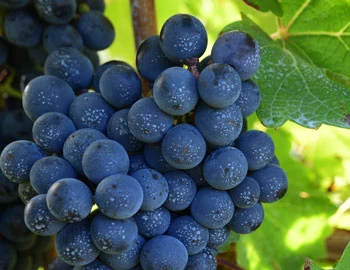
Cabernet Sauvignon
The backbone of Bordeaux
The Cabernet Sauvignon gives the Bordeaux its backbone, yielding deep violet wines with powerful tannins and endless ripening potential. It is the top dog in Médoc, and is placed in all five premier crus of Bordelais. When young, it often appears strict and unapproachable, but with advancing years, its tannins round off. It is wonderfully velvety, and yet always maintains its freshness. Typical flavours include cassis, graphite and cedar. Wherever Cabernet Sauvignon is found, Merlot is not far away. It complements the robust structure of Cabernet with softness, fruit and richness. The Cabernet Sauvignon is the most-exported vine in the world. It delivers persuasive qualities in Italy as an ingredient of the Super Tuscan, or as the flagship variety from California. There, it is lovingly titled “Cab Sauv”. Meat fans should be aware that it fantastically accompanies a grilled entrecôte. The family tree of Cabernet Sauvignon is surprising: its parents are Cabernet Franc and the white Sauvignon blanc.
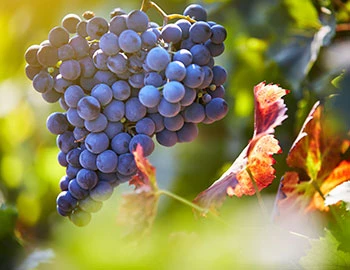
Shiraz
A hint of pepper
The legend stubbornly persists that the Syrah variety came from the Persian city of Shiraz. Yet, researchers have shown that it is a natural crossing of two old French varieties: the red Dureza from the Rhône Valley and the white Mondeuse blanche from Savoy. Wines from Syrah are gentle and concentrated. They smell of dark berries, violets and liquorice, and amaze with a piquant touch of white pepper. As varietal wines, they are found on the northern Rhone, as in the Hermitage or Côte Rôtie appellations, as well as in Swiss Valais. In the southern Rhône Valley, Syrah is often wedded with Grenache and Mourvèdre. In 1832, a Frenchman brought the variety to Australia, where it became the emblem of the national wine industry. There, the weightiest versions develop with typical notes of tar and chocolate.
Cabernet Sauvignon
The backbone of Bordeaux
The Cabernet Sauvignon gives the Bordeaux its backbone, yielding deep violet wines with powerful tannins and endless ripening potential. It is the top dog in Médoc, and is placed in all five premier crus of Bordelais. When young, it often appears strict and unapproachable, but with advancing years, its tannins round off. It is wonderfully velvety, and yet always maintains its freshness. Typical flavours include cassis, graphite and cedar. Wherever Cabernet Sauvignon is found, Merlot is not far away. It complements the robust structure of Cabernet with softness, fruit and richness. The Cabernet Sauvignon is the most-exported vine in the world. It delivers persuasive qualities in Italy as an ingredient of the Super Tuscan, or as the flagship variety from California. There, it is lovingly titled “Cab Sauv”. Meat fans should be aware that it fantastically accompanies a grilled entrecôte. The family tree of Cabernet Sauvignon is surprising: its parents are Cabernet Franc and the white Sauvignon blanc.
Grenache
Grenache seldom comes alone
Spaniards and Sardinians make the Grenache contentious: both claim it originated from their country. In fact, it had already appeared in both places by the 16th century. But a large number of mutations in Spain indicates that it has deeper roots on the Iberian Peninsula. The Grenache is meaty and spicy, with a wonderful, fruity sweetness and rich aromas of blackberry, cassis, plums and pepper. Under the name Garnacha, it contributes fullness to the Rioja. In Sardinia it is called Cannonau, where it yields strong, expressive wines. But its stronghold is in France. Grenache is the star in Châteauneuf-du-Pape and streams into many other assemblages from the south. Its preferred partners are Syrah and Mourvèdre. This blend is also very popular abroad. In Australia, these wines are simply called "GSM".