
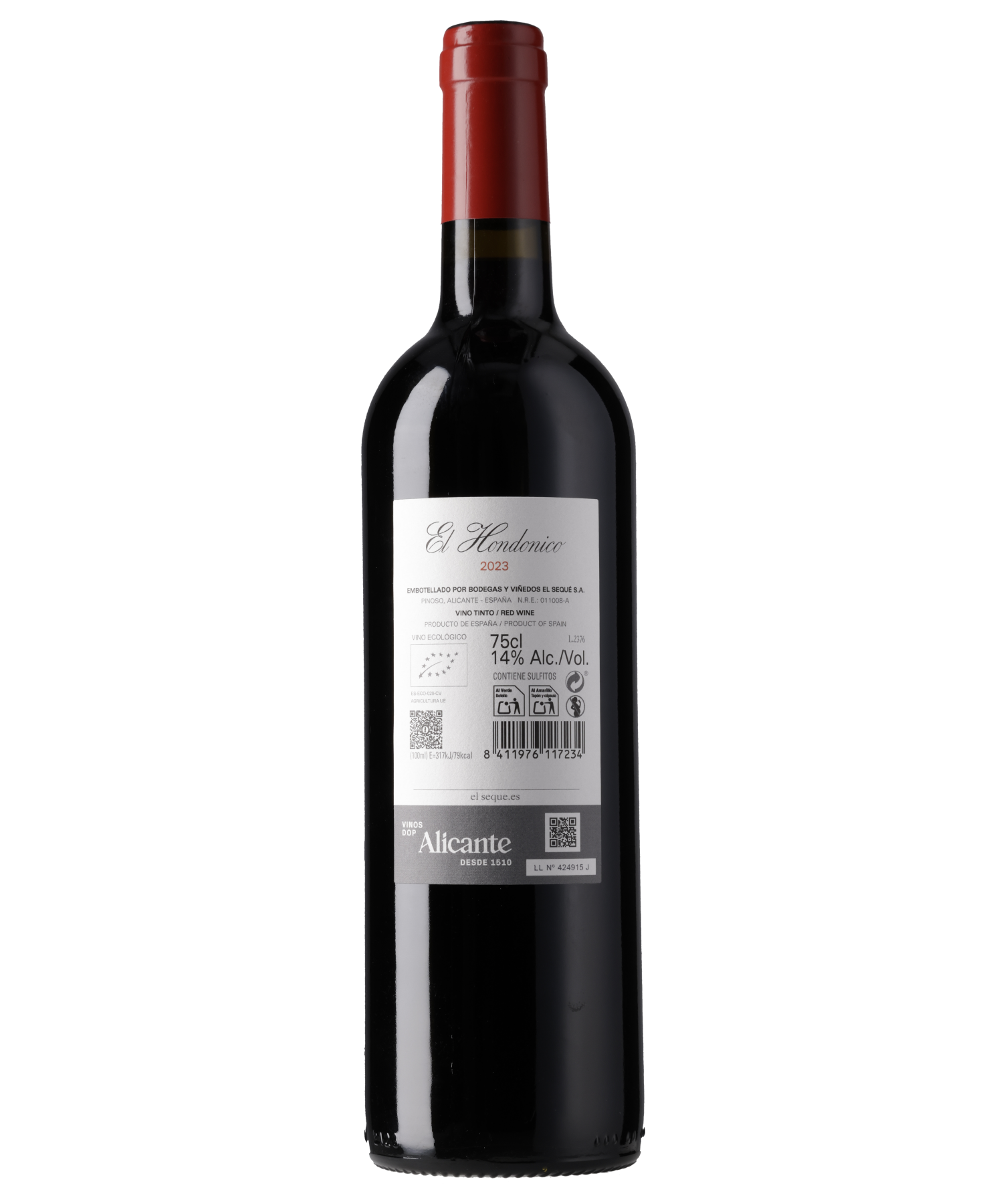
El Hondónico 2023
DO Alicante, Bodegas y Viñedos El Sequé, 750 ml


Monastrell Reimagined
- The cool northern exposure lends this Monastrell a sense of freshness and finesse.
- Dark berries, herbs and balsamic notes. Silky and elegant.
- Pairs well with lamb, game, mushroom dishes and hearty potato dishes.
Description
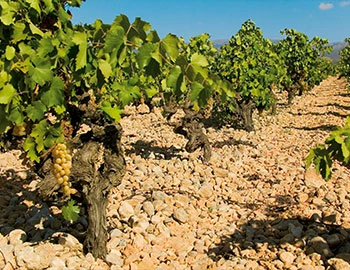
Behind El Hondonico, a tribute to the historical heritage of the Monastrell grape variety in Alicante, are the López de Lacalle family and the local winemaker Agapito Rico. The grapes for this wine, launched for the first time with the 2023 vintage, come from an old vineyard in Abanilla. The north-facing site, with its deep sandy soils and calcareous gravel, creates a cooler microclimate and lends this robust Mediterranean grape a surprising freshness. With this new interpretation of the Monastrell grape variety, El Hondonico reveals its particularly elegant side. The wine’s depth, the silkiness of its tannins and its balsamic character combine to form a multi-layered whole. Red and dark fruits, aromatic herbs and subtle earthy notes lend the wine tension and precision. It pairs wonderfully with lamb, game, mushroom dishes and rustic potato specialities. Particularly delightful: pairing it with mature Manchego.
Attributes
| Grape variety: | Monastrell |
| Producer: | Bodegas y Viñedos El Sequé |
| Origin: | Spain / Alicante / Pinoso |
| Food Pairing: | Wild specialities, Roasted lamb gigot, Crispy roast chicken, Mushroom ragout |
| Vinification: | fermentation in steel tank, short must fermentation, fermentation at low temperatures, Pumping over |
| Maturation: | in large wooden barrel/foudre |
| Maturation duration: | 12 months |
| Volume: | 14.0 % |
| Note: | Contains sulphites |
Bodegas y Viñedos El Sequé
In the hinterland of Alicante, in the municipality of Pinoso, El Sequé has emerged as one of Spain’s most exciting Monastrell projects. Behind the winery is the López de Lacalle family, who have made their mark on some of the country’s most renowned wine estates, including Artadi in Rioja, Artazu in Navarre and Izar-Leku in the Basque Country.
The region is one of the Mediterranean’s historic wine-growing areas. The Phoenicians and Romans left their mark here long ago. Against this backdrop steeped in tradition, El Sequé pursues a clear aim: to create wines that authentically reflect their origins and express the distinctive characteristics of the landscape, climate and grape variety.
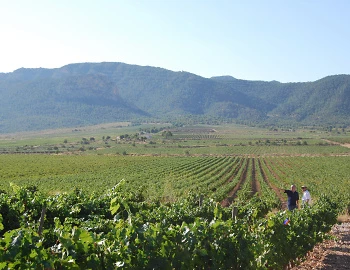
Today, the estate comprises around 37 hectares of vineyards on poor, sandy and limestone soils. The vineyards are situated at an altitude of between 600 and 650 metres, where hot days give way to surprisingly cool nights. These significant temperature variations lend the wines freshness and vibrancy, whilst the nutrient-poor soils, characterised by gravel and limestone, impart character and depth.
The focus is on the Monastrell grape variety, the very soul of the project. Many of the old bush vines are over 50 years old and have deep roots in the dry soil. Unlike many powerful, opulent expressions of this variety, Monastrell at El Sequé reveals a remarkably elegant side: intense fruit, Mediterranean herbs and balsamic freshness combine with precision and finesse.
Monastrell
Hot-blooded Spaniard
It cannot be hot enough for the Monastrell grape. It grows around the Mediterranean, where the summers are long and hot and the winters mild. At only 200 metres in elevation, or 80 kilometres from the coast, its grapes have problems ripening. It was likely born in the Valencia region. According to written records, it was already counted among the most important varieties in 1460. Its exact origin is thought to be the Camp de Morvedre area. From there, it migrated in the 17th century to Provence, where it was christened Mourvèdre. Its wines are deeply dark, with intense blackberry aromas, rich tannins and moderate acidity. They enter into the most beautiful harmonies with other varieties from the south, such as Garnacha, Carignan or Syrah. The Mourvèdre is the main ingredient of red wines of Bandol; it also flows into the Châteauneuf-du-Pape. On the Spanish Levante coast, it is also pressed solo.
Spain
Spain – Variety and perfection
“Somewhere in la Mancha, in a place whose name I do not care to remember...,” begins Don Quixote's odyssey.
The most famous part is definitely when Don Quixote thinks windmills are his enemy and wants to fight them – until they nearly kill him. It’s possible there was a bit too much of the La Mancha wine at play. Spanish vines fight for their survival in rugged landscapes, battling fierce drought and rough soils. But they fight well.