
Château Suduiraut 2005
AC Sauternes Cru classé, 750 ml


Description
Citing Robert Parker The Wine Advocate "With 163 grams per liter of residual sugar, the 2005 Suduiraut exhales a deep, complex bouquet of exotic fruits, pineapple, apricot and spices despite a slight touch of volatile acidity. Medium to full-bodied, rich and concentrated with a stunning "rôti"—the French term for the consequence of noble rot—it’s satiny and chiseled with racy acids and a long, mineral and saline finish underlined by gastronomic bitterness. This splendid Sauternes, a blend of 97% Sémillon and 3% Sauvignon Blanc, was matured for 18 months in oak barrels (65% new and 35% one year) and was harvested in four tries between September 26 and October 17."
Attributes
| Grape variety: | Sémillon, Sauvignon Blanc |
| Producer: | Château Suduiraut |
| Origin: | France / Bordeaux / Sauternes, Barsac & Cadillac |
| Other vintages: | 2025 2001 |
| Drinking temperature: | 10 to 12 °C |
| Volume: | 13.5 % |
| Note: | Contains sulphites |
Sauvignon Blanc
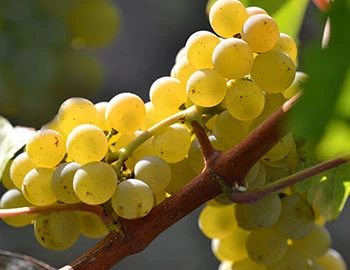
The Sauvignon blanc can be recognized with your eyes closed. Its typical bouquet is marked by green notes: freshly cut grass, tomato bunches, gooseberry. Citrus fruits, cassis and flint join into the mix. In warmer latitudes it also shows exotic aromas, such as passion fruit. Its acidity is decidedly lively. In all likelihood, it comes from the Loire Valley, where it is vinified in Pouilly-Fumé and Sancerre in its purest form: varietally, and without timber. In the 18th century, it found its way to Bordeaux. Ambitious producers assemble it there with Sémillon into substantial whites, which are aged in oak barrels. The Sauvignon blanc has been a sensational success in the past 20 years in New Zealand. With its refreshing sweet-and-sour style, winemakers from down under have conquered the world. The rich Sauvignons from Styria and crisp examples of South Tyrol and Friuli are worth mentioning as well. It pairs with anything from the sea. Or do it like they do on the Loire, and enjoy it with goat cheese.
Sémillon
The fungi be thanked
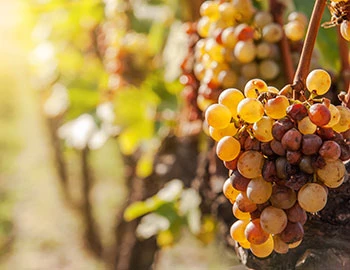
The Sémillon grape is the basis of the legendary sweet wines of Sauternes. Its origins are there, in the southern part of the Bordeaux region. Its secret to success is its susceptibility to the Botrytis fungus, which pierces the skin of the ripe berries. Thus the water evaporates, and the sugar in the fruits concentrates. The musts are as thick as syrup. They present the citrus-fresh, fruity aromas of the Sémillon varieties. In addition, the Botrytis fungus contributes complex notes of honey, dry apricot and candied orange to the wine. The Sémillon is closely related to the Sauvignon blanc, and almost all sweet wines from Sauternes and its surroundings contain a small proportion of Sauvignon. The dry whites from Bordeaux are the opposite: the Sémillon mostly plays the supporting role. In early-19-century South Africa, Sémillon was the most planted grape. However, only vanishingly small quantities still grow there today. However, the vine has since taken root in California and Australia.
Bordeaux
Bordeaux: high prestige, high quality
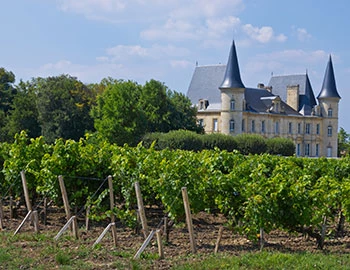
With a total area of around 115,000 hectares, Bordeaux may not be France’s largest wine-growing region, but it is certainly its most prestigious. The range of wines produced here today is enormous: ranging from red everyday wines with a great relationship between price and quality to exclusive, and accordingly expensive, premier crus. Elegant white wines and noble sweet specialties round out the spectrum.
France
France – Philosophy in a bottle
According to French philosophy, wine should be an expression of the soil and climate. They use the word “terroir” to describe this. Terroir makes every wine different, and many especially good. French wine is regarded worldwide as an expression of cultural perfection. The French believe that humans are responsible for the quality of the berries, the vine variety for their character, and nature for the quantity. This philosophy can be expressed succinctly as: “the truth is the vineyard, not the man.”