
Ried Gaisberg 1. Lage Riesling 2022
DAC Kamptal, Schloss Gobelsburg, 750 ml


Exceptional Riesling
- Riesling from the renowned Ried Gaisberg vineyard in Kamptal.
- Stone fruit on the nose, a delicate texture on the palate, and a mineral finish.
- Pairs well with fish, seafood, crispy chicken and mildly spiced Asian dishes.
Description
Some wines are a real delight even when young, whilst at the same time offering a glimpse of what lies ahead. This Riesling falls squarely into this category. The‘Ried Gaisberg single vineyard stretches across the municipalities of Kammern, Zöbing and Strass in the Kamptal and is one of the oldest vineyards cultivated by Schloss Gobelsburg. The primary rock soils, characterised by gneiss, slate and amphibolite, lend the wines their unmistakable character. Stone fruit, delicate citrus notes and a hint of flint define the multi-layered bouquet. On the palate, it is juicy and elegant, with a fine texture, invigorating freshness and a salty minerality in the long finish. A delight to drink even now, this Riesling also has the potential to gain in complexity and depth over many years. Our tip: serve with lobster, scallops or turbot. For those who prefer something more exotic, pair it with sushi or subtly spiced Asian dishes.
Ried Gaisberg 1. ÖTW-Riesling 2022 was awarded 95 points by Falstaff.
Attributes
| Grape variety: | Riesling |
| Producer: | Weingut Schloss Gobelsburg |
| Origin: | Austria / Niederösterreich / Kamptal |
| Other vintages: | 2023 2017 2016 2014 |
| Label: | Vegan |
| Ripening potential: | 2 to 15 years |
| Drinking temperature: | 10 to 12 °C |
| Food Pairing: | Fish ragout with saffron sauce, Mild Asian dishes, Succulent chicken breast with cream sauc, Giant crevettes, grilled langoustines, Vegetable cous-cous |
| Vinification: | soft pressing, fermentation in steel tank |
| Harvest: | hand-picking, in small boxes, strict selection |
| Maturation: | in large wooden barrel/foudre |
| Bottling: | filtration |
| Volume: | 13.0 % |
| Note: | Contains sulphites |
Weingut Schloss Gobelsburg
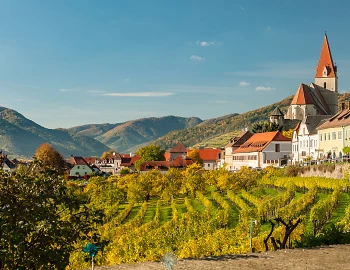
The first written evidence of Schloss Gobelsburg dates from 1074, but it was in 1171 that the Cistercian monks from the Zwettl monastery obtained the first vineyards at Heiligenstein and at Gaisberg in the Kamptal. Visitors entering the baroque-style complex built on a slight mound sense this tradition, this spirit, this experience accumulated over the centuries. The view takes in all the surroundings, from the village of Gobelsburg to the vine-covered hills of Heiligenstein. Inside, near the parish church where couples say yes for life, when the weather is pleasant, the pretty and romantic garden invites all to rest for a while.
Grüner Veltliner and Riesling cover most of the countryside, while Zweigelt, Pinot Noir, St. Laurent and Merlot occupy about a quarter of the surface. Production guidelines are strict, and the winegrowing has adapted to the latest developments while still respecting the methods practiced by the monks. Wines are vinified and aged exceptionally gently. The Gobelsburg team tries to obtain authentic wines which respect and express their origin’s personality and individuality. Michael Moosbrugger’s ingeniously simple idea illustrates this quest for progress: casks on wheels use gravity to avoid damaging the wine through pumping. The casks are made from wood from nearby Manhartsberg and not from popular French or American oak.
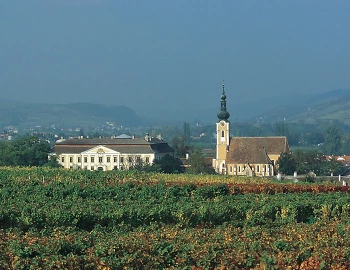
Riesling
The cold-weather king
The Riesling is the flagship of the German wine industry. It grows from north to south in all growing areas. It is also comfortable in the neighbouring Alsace region and in Austria. Its specialty is being vinified to a variety of degrees of sweetness, from bone-dry wines to ice wine. Moreover, thanks to its spirited acidity, it ages better than many reds. The typical Riesling smells of citrus, peach and apricot, shows hints of flint, and with maturity develops an idiosyncratic petrol note. It reflects its terroir like hardly any other white variety. Thus, it often gets fuller and more aromatic in Austria than in Germany. In Alsace, in turn, it has a particular mineral taste. Riesling is a wonderful culinary companion. It fits well not only with fish and shellfish, but also takes the heaviness from hearty meals. And with a fine sweetness and acidity balance, it works wonders for Asian cuisine.
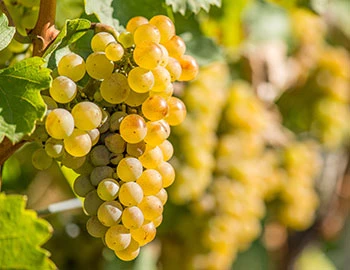
Kamptal
Kamptal: a dynamic atmosphere north of the Danube
With an ever-growing number of leading vintners, Kamptal has increasingly stood out in recent years from the shadow of the legendary Wachau region. The basis for this are the various terroirs in this broad-ranging valley. At Loisium, the region is also host to a spectacular, futuristic visitor center.
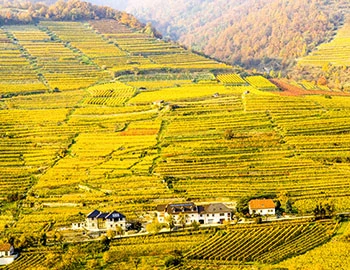
Niederösterreich
Lower Austria: crus near and far from the Danube
Austria's largest state is also its largest wine region. 46,000 hectares are planted with vines in Lower Austria. It is a heterogenic wine region, consisting of eight wine growing areas. While white varieties like Grüner Veltliner and Riesling dominate in the areas north and west of Vienna, red varieties set the tone in the south and in the southeast (Thermenregion and Carnuntum). The internationally famous white crus from Grüner Veltliner and Riesling develop in the picturesque Wachau and Kamptal.
Austria
Austria – Sumptuous culture, accessible to all
Austria is characterized by unbelievable topographical diversity. A flat steppe in the east, forests and hills in the Alpine regions, wetlands and Mediterranean landscapes in the south. This in addition to a rich tradition and even greater love. It’s no surprise that the Romans found joy on this patch of Earth and cultivated wine growing. Austrian wine is not abundant, but it is high quality.