
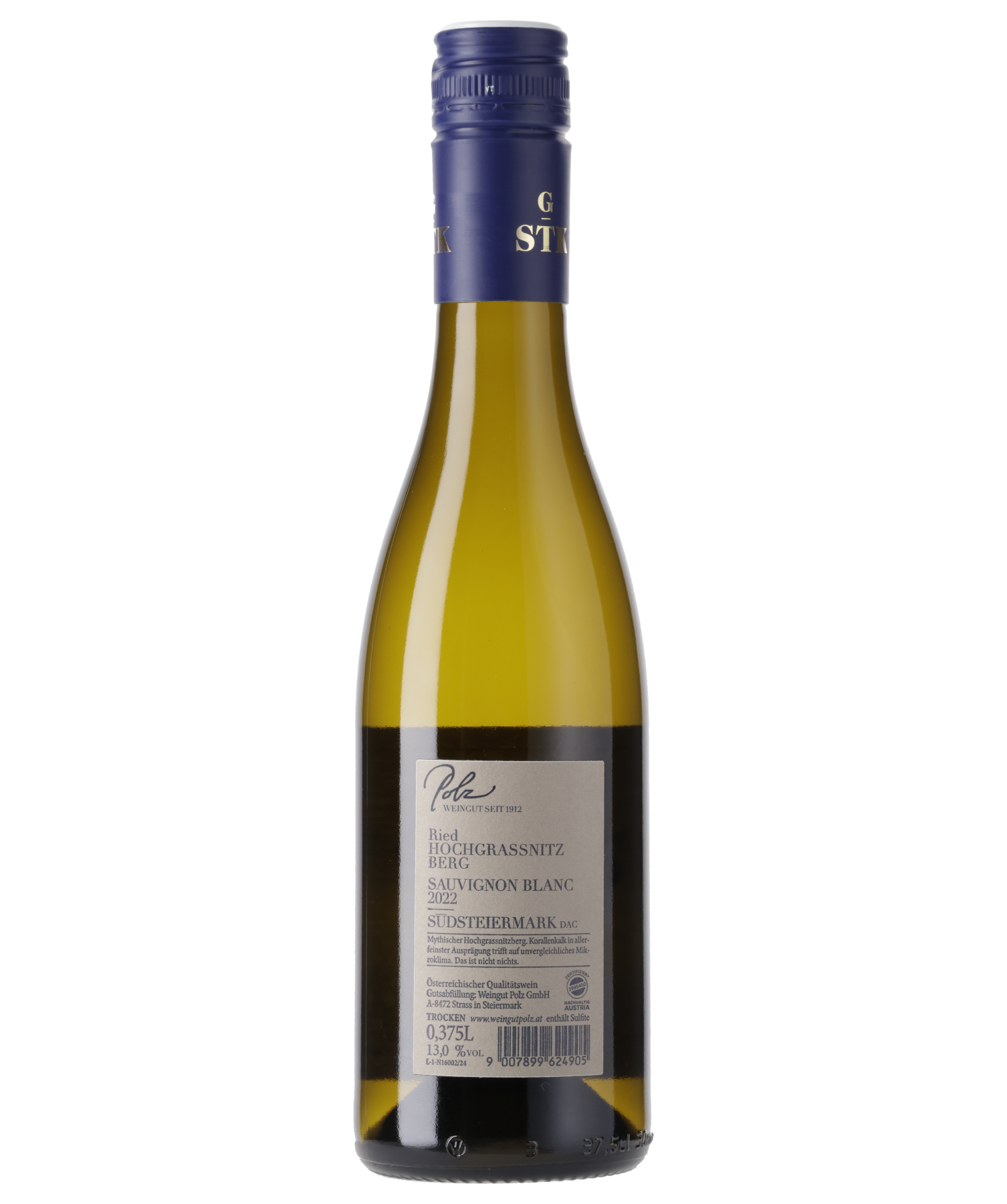
Sauvignon Blanc Ried Hochgrassnitzberg 2022
DAC Südsteiermark, Polz, 375 ml


Sauvignon Blanc with provenance
- From the Ried Hochgrassnitzberg, one of the most renowned vineyards in Southern Styria.
- Floral notes, lemon zest and fresh thyme combine with focus and precision.
- To accompany bouillabaisse, saltwater and freshwater fish, seafood risotto or goat’s cheese.
Description
A Sauvignon Blanc that impressively demonstrates the potential of a Ried (vineyard site). The Hochgrassnitzberg is one of the most renowned vineyard sites in Southern Styria and produces wines with depth, complexity and remarkable ageing potential. Floral and spicy notes accompany intense aromas of Amalfi lemon zest, lemongrass and fresh thyme. On the palate, concentrated minerality and a fine structure combine with impressive precision. An exceptional Sauvignon Blanc with a long finish. Perfect with bouillabaisse, saltwater and freshwater fish, seafood risotto, sophisticated vegetable dishes or goat’s cheese au gratin.
Tasting – The Art of Wine Selection at the Baur au Lac

Meet over 20 wine and spirits producers, benefit from attractive special offers, and attend exclusive masterclasses featuring aged wines. Limited places available.
Sunday, November 15, 2026 | 2.00 pm until 7.00 pm
Monday, November 16, 2026 | 2.00 pm until 8.00 pm
Attributes
| Grape variety: | Sauvignon Blanc |
| Producer: | Polz |
| Origin: | Austria / Steiermark / Südsteiermark |
| Other bottle sizes: | 750 ml |
| Other vintages: | 2023 |
| Label: | Vegan |
| Ripening potential: | 3 to 12 years |
| Drinking temperature: | 12 to 14 °C |
| Food Pairing: | Bouillabaisse, Mussels au gratin, Asparagus specialities, Smoked fish, Risotto ai frutti di mare, Goat's cheese |
| Vinification: | fermentation in steel tank |
| Harvest: | hand-picking |
| Maturation: | in large wooden barrel/foudre |
| Maturation duration: | 15 months |
| Volume: | 13.0 % |
| Note: | Contains sulphites |
Polz
The family vineyard of Erich Polz is situated in an idyllic field in the middle of hilly Southern Styria, about an hour’s drive south of Graz. The business was originally founded in 1912. In the late 1980s, the brothers took over their parents’ vineyard. Christoph Polz, Erich’s son, became the fourth generation to assume the role of winemaker in 2011.
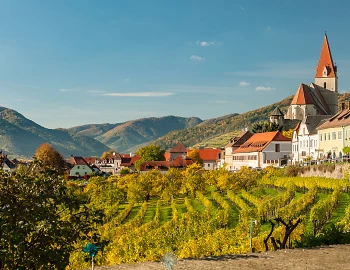
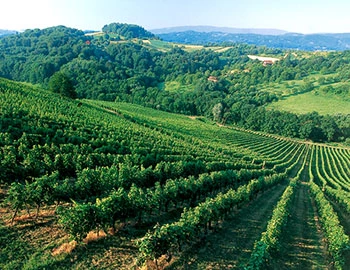
The Polz vineyards are situated in one of the best winegrowing regions of Southern Styria around the Grassnitzberg where the Illyrian climate prevails. The area is characterised by a special harmony of Alpine, Pannonian and Mediterranean climates. As a result, the wine grown here is of the finest quality. The geological composition of the soil, many hours of sunshine and well-distributed rainfall offer almost perfect conditions for viticulture.

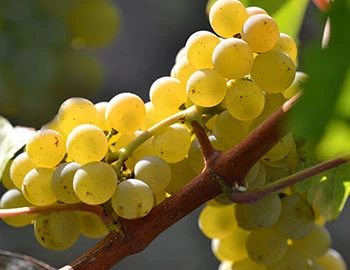
Sauvignon Blanc
The Sauvignon blanc can be recognized with your eyes closed. Its typical bouquet is marked by green notes: freshly cut grass, tomato bunches, gooseberry. Citrus fruits, cassis and flint join into the mix. In warmer latitudes it also shows exotic aromas, such as passion fruit. Its acidity is decidedly lively. In all likelihood, it comes from the Loire Valley, where it is vinified in Pouilly-Fumé and Sancerre in its purest form: varietally, and without timber. In the 18th century, it found its way to Bordeaux. Ambitious producers assemble it there with Sémillon into substantial whites, which are aged in oak barrels. The Sauvignon blanc has been a sensational success in the past 20 years in New Zealand. With its refreshing sweet-and-sour style, winemakers from down under have conquered the world. The rich Sauvignons from Styria and crisp examples of South Tyrol and Friuli are worth mentioning as well. It pairs with anything from the sea. Or do it like they do on the Loire, and enjoy it with goat cheese.
Südsteiermark
Südsteiermark: Weisse Klasse in vielen Nuancen
Nirgendwo sonst zeigt der Sauvignon Blanc so einen Facettenreichtum wie in der Südsteiermark. Als «Steirische Klassik» lernen wir ihn geradlinig und erfrischend unkompliziert kennen, im «High End»-Bereich begegnet er uns als vielschichtige und auch lagerungsfähige Lagen-Selektion von alten Reben, die heute zumeist im grossen Eichenfass ausgebaut wird. Neben dem Sauvignon überzeugen hier besonders auch die Muskateller Weine. Sie vereinen intensive Aromatik mit animierender Bekömmlichkeit.
Steiermark
Styria: the fresh, white wave
The southern cultivation area of Austria surprises with its refreshing white wines. Sauvignon Blanc, Riesling and Chardonnay (referred to here as Morillon) impress with their own profiles. Since the opening of the border with Slovenia – where the Iron Curtain once hung in its more moderate form – a dynamic, cross-border wine culture has developed. It almost seems as if the vibrancy of the hilly landscapes is reflected in the wines themselves.
Austria
Austria – Sumptuous culture, accessible to all
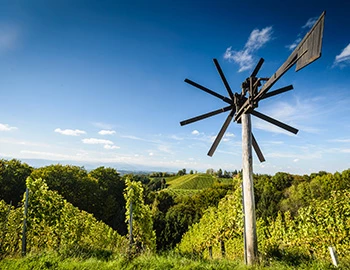
Austria is characterized by unbelievable topographical diversity. A flat steppe in the east, forests and hills in the Alpine regions, wetlands and Mediterranean landscapes in the south. This in addition to a rich tradition and even greater love. It’s no surprise that the Romans found joy on this patch of Earth and cultivated wine growing. Austrian wine is not abundant, but it is high quality.