
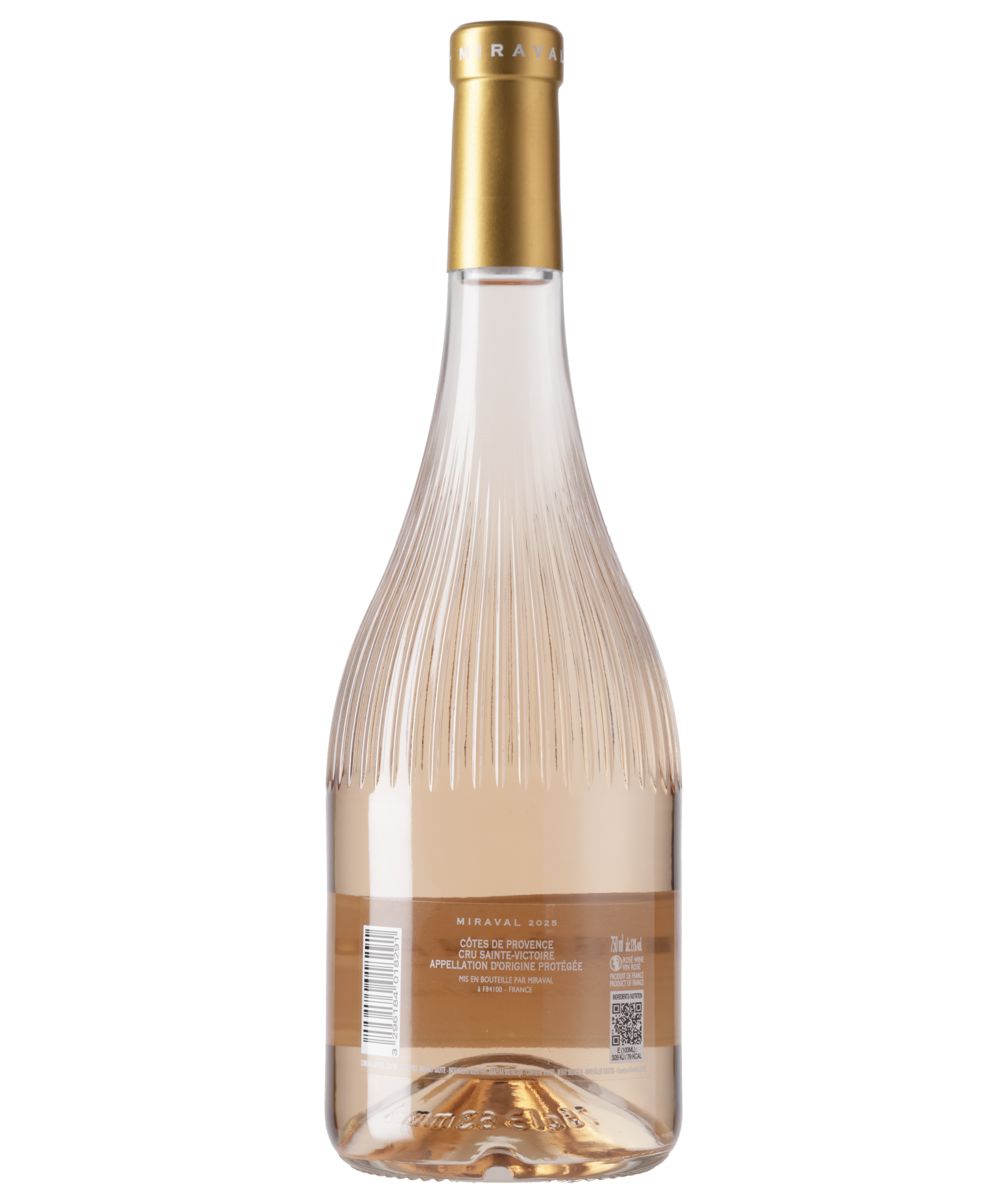
Miraval Cru Sainte-Victoire Rosé 2025
AOP Côtes de Provence, Famille Perrin, 750 ml


The Magic of Provence
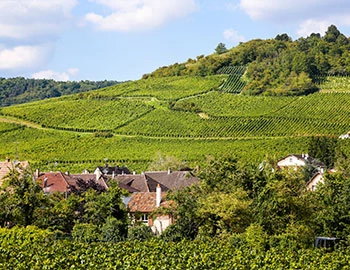
- Sun, the mistral and chalky soils give this rosé its distinctive character.
- A bouquet of peach, raspberries and citrus fruits. Fresh, aromatic and elegant on the palate.
- Perfect with Mediterranean dishes, fish, seafood or light salads.
Description
The Miraval Rosé Cru Sainte-Victoire perfectly captures the lightness and beauty of Provence. The vineyards benefit from a Mediterranean climate with plenty of sunshine, whilst the strong Mistral wind provides natural cooling for the grapes. This results in wines with great freshness, finesse and character. On the nose, delicate aromas of peach, raspberries and citrus fruits delight the senses. On the palate, the rosé is fresh and aromatic, with a subtle mineral note and an elegant character. Whether paired with Mediterranean dishes, fish, seafood or light salads – this is a rosé that tastes of sunshine, holidays and savoir-vivre.
Attributes
| Grape variety: | Cinsault, Grenache, Syrah |
| Producer: | Famille Perrin |
| Origin: | France / Provence / Côtes de Provence |
| Ripening potential: | 1 to 4 years |
| Drinking temperature: | 8 to 10 °C |
| Food Pairing: | Goat's cheese, Sushi, Sashimi, Ceviche, Risotto ai frutti di mare, Succulent chicken breast with cream sauc |
| Volume: | 13.0 % |
| Note: | Contains sulphites |
Famille Perrin
Nestled amongst the rolling hills of Correns, Château Miraval is now one of Provence’s best-known wine estates. This historic estate combines the beauty of the South of France with a clear vision for modern, high-quality rosé wines, and has gained international renown thanks to Brad Pitt and Angelina Jolie.
In partnership with the renowned Perrin family, whose Château de Beaucastel ranks among France’s most prestigious estates, Miraval has become one of Provence’s most sought-after producers of rosé. Today, Brad Pitt remains associated with the estate, whilst the Perrin family, drawing on their decades of expertise, continues to shape the style and quality of the wines.

Cinsault
Sun in a glass
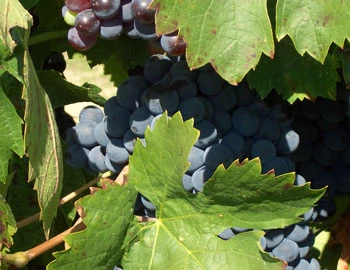
The southern French Cinsault, also written Cinsaut, is a curiosity among the grape varieties. It belongs to the so-called “dyer grapes”. These are red grapes in which the pigments sit not only in the skins but also in the flesh. That means, when the Cinsault is pressed, pink juice results, rather than the white you see from other grapes. Previously, the Cinsault was used to spice up lighter-coloured Burgundy. But now it has become emancipated. With a soft, fruity style, seductive raspberry and strawberry aromas and good aging potential, it mixes with the most renowned growths from the southern Rhône, around the Châteauneuf-du-Pape. Solo, it yields wonderfully aromatic rosés.
Syrah
A hint of pepper
The legend stubbornly persists that the Syrah variety came from the Persian city of Shiraz. Yet, researchers have shown that it is a natural crossing of two old French varieties: the red Dureza from the Rhône Valley and the white Mondeuse blanche from Savoy. Wines from Syrah are gentle and concentrated. They smell of dark berries, violets and liquorice, and amaze with a piquant touch of white pepper. As varietal wines, they are found on the northern Rhone, as in the Hermitage or Côte Rôtie appellations, as well as in Swiss Valais. In the southern Rhône Valley, Syrah is often wedded with Grenache and Mourvèdre. In 1832, a Frenchman brought the variety to Australia, where it became the emblem of the national wine industry. There, the weightiest versions develop with typical notes of tar and chocolate.
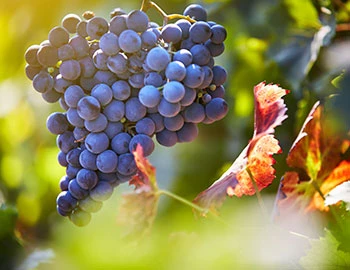
Grenache
Grenache seldom comes alone
Spaniards and Sardinians make the Grenache contentious: both claim it originated from their country. In fact, it had already appeared in both places by the 16th century. But a large number of mutations in Spain indicates that it has deeper roots on the Iberian Peninsula. The Grenache is meaty and spicy, with a wonderful, fruity sweetness and rich aromas of blackberry, cassis, plums and pepper. Under the name Garnacha, it contributes fullness to the Rioja. In Sardinia it is called Cannonau, where it yields strong, expressive wines. But its stronghold is in France. Grenache is the star in Châteauneuf-du-Pape and streams into many other assemblages from the south. Its preferred partners are Syrah and Mourvèdre. This blend is also very popular abroad. In Australia, these wines are simply called "GSM".
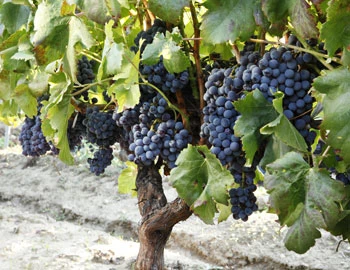
France
France – Philosophy in a bottle
According to French philosophy, wine should be an expression of the soil and climate. They use the word “terroir” to describe this. Terroir makes every wine different, and many especially good. French wine is regarded worldwide as an expression of cultural perfection. The French believe that humans are responsible for the quality of the berries, the vine variety for their character, and nature for the quantity. This philosophy can be expressed succinctly as: “the truth is the vineyard, not the man.”